Automate Ecommerce Shipping Payment Processing (Ultimate Guide)
Managing the physical movement of goods is only half the battle in online retail; managing the financial transactions tied to those shipments is equally challenging. High order volumes, tight profit margins, and fluctuating carrier rates create a complex financial web. When businesses rely on fragmented systems to settle freight bills, top-up carrier wallets, and reconcile Cash on Delivery (COD) funds, the entire supply chain suffers.
Summary: Automate Ecommerce Shipping Payment Processing
| Key Area | Traditional Logistics Operations | Automated Logistics Operations |
|---|---|---|
| Payment Routing | Manual bank transfers and paper checks. | Instant API-driven automated processing. |
| Carrier Management | Multiple fragmented wallets across apps. | Centralized "One Wallet" system. |
| Cash Flow | Capital trapped in delayed COD settlements. | Real-time COD monitoring and fast settlement. |
| Reconciliation | Days of manual spreadsheet matching. | Instant synchronization with accounting software. |
| Scalability | Requires hiring more Accounts Payable staff. | Scales automatically without extra headcount. |
The Hidden Costs of Manual Financial Operations
Scattered Funds Across Multiple Platforms
A major hurdle for scaling merchants is the necessity of maintaining balances across several different courier applications. When capital is dispersed across five different carrier wallets, liquidity decreases. If one wallet runs empty during a high-volume sales event, shipments halt until a manual bank transfer is initiated and cleared.
The Cash on Delivery (COD) Dilemma
In many regions, COD remains a dominant payment preference. However, it creates severe cash flow disruptions. Businesses often wait weeks for logistics partners to remit collected funds. During this waiting period, capital is locked up, making it difficult to restock inventory or fund marketing campaigns.
Administrative Overhead and Reconciliation Errors
Accounts payable departments often spend the majority of their time matching complex shipping invoices against original orders. Discrepancies regarding weight limits, fuel surcharges, and remote area fees lead to billing disputes. Manual reconciliation is prone to human error, resulting in lost revenue and inaccurate financial reporting.
Understanding Automated Shipping Payment Solutions

To overcome these financial bottlenecks, forward-thinking businesses are integrating automated shipping payment solutions directly into their operational infrastructure. These systems replace manual bank transfers and individual app top-ups with a centralized, technology-driven financial layer. A robust automated system consolidates all logistical finances into a single dashboard. Instead of interacting with dozens of different carrier billing departments, the software acts as a unified financial hub.
Step-by-Step: How to Automate Delivery Fee Payments

Transitioning away from manual accounting requires a strategic approach. Here is a clear framework detailing how to automate delivery fee payments effectively:
- Audit Current Workflows: Document the existing process for paying couriers. Identify bottlenecks, such as the time it takes to approve invoices, the frequency of empty carrier wallets, and the rate of manual reconciliation errors.
- Centralize Logistics Management: Adopt a platform that aggregates multiple logistics partners. Attempting to automate payments across five disconnected carrier APIs is inefficient. A unified infrastructure solves this by offering a single integration point.
- Implement a Unified Wallet: Shift from funding individual carrier accounts to funding one centralized wallet. This consolidates capital and ensures that funds are always available for any chosen carrier, preventing dispatch delays.
- Connect Core Business Systems: Utilize API integrations to connect the logistics platform directly to Point of Sale (POS) systems, e-commerce storefronts, and enterprise resource planning (ERP) software.
- Establish Automated Rules: Configure the system to automatically assign the most cost-effective courier and process the exact fee instantly upon order creation.
- Monitor Analytics: Routinely review financial dashboards to track shipping expenditures, evaluate carrier efficiency, and monitor COD settlement timelines.
Strategic Implementation: Auto Pay Shipping Costs for Online Store Operations
For high-volume merchants, the ability to auto pay shipping costs for online store fulfillment directly correlates with order processing speed. During peak seasons, warehouse staff cannot afford to pause fulfillment to request financial top-ups from the accounting department.
By setting up an automated payment infrastructure, the moment an order is confirmed by the consumer, the system evaluates the destination, package dimensions, and available couriers. It then selects the optimal carrier, generates the unified waybill, and instantly deducts the exact shipping cost from a centralized financial pool. This frictionless workflow ensures that the physical dispatch of goods is never interrupted by administrative delays. Furthermore, it completely eliminates the need to manually verify credit card transactions for every individual freight booking, drastically reducing transaction fees and processing times.
Managing Cash Flow: Allingo Prepaid vs Postpaid Accounts
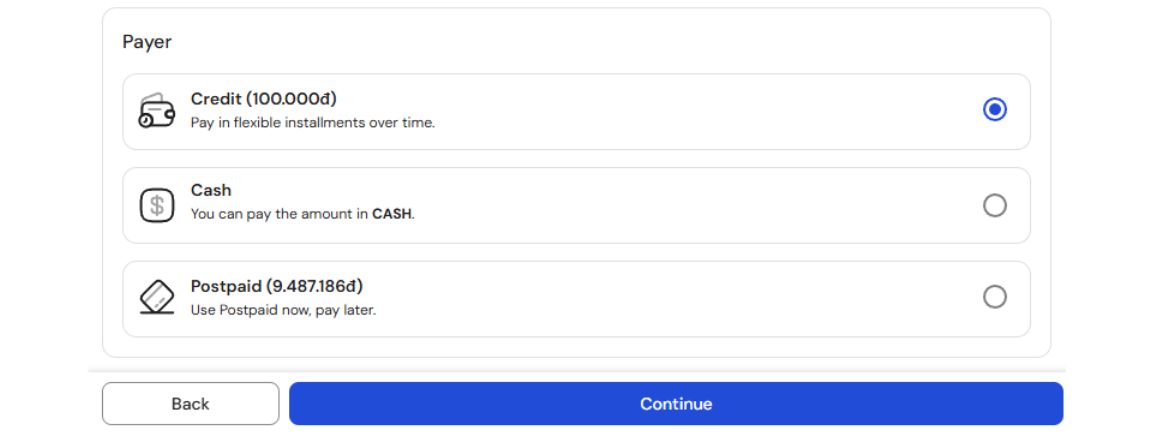
Choosing the correct financial structure is vital for maintaining liquidity. A modern logistics intelligence layer like Allingo offers flexible payment models tailored to different operational needs. Understanding the difference between Allingo prepaid vs postpaid accounts helps businesses align their logistics expenses with their revenue cycles.
The Prepaid Model
The prepaid structure operates via a centralized "One Wallet" system. Businesses deposit funds into this single balance, which is then universally accepted across all connected carrier partners.
- Predictable Budgeting: Expenses are capped by the wallet balance, preventing unexpected freight overages.
- Instant Dispatching: Because funds are pre-cleared, the system can automate ecommerce shipping payment processing instantly, allowing for the fastest possible order fulfillment.
- Ease of Access: Top-ups can be automated via standard banking protocols like VietQR, ensuring the wallet is continuously funded without manual intervention.
The Postpaid Model
For established enterprises with high daily order volumes and proven credit histories, the postpaid model offers maximum cash flow flexibility.
- Capital Preservation: Shipping fees are aggregated and billed on a scheduled cycle (e.g., weekly or monthly). This allows the business to reinvest daily revenue immediately rather than tying it up in logistics prepayments.
- Streamlined Accounts Payable: Instead of processing hundreds of micro-transactions, the finance department processes a single, consolidated invoice, greatly reducing administrative friction.
- Advanced Reconciliation: Combined with deep API integrations, postpaid accounts simplify the auditing process, matching aggregated billing directly to fulfilled order IDs within the ERP system.
Both models integrate seamlessly with Allingo's COD Monitoring tools, ensuring that incoming funds are tracked meticulously against outgoing operational expenses.
Transforming Logistics Through Intelligent Infrastructure
The logistics sector can no longer rely on fragmented financial workflows and manual data entry. To scale effectively, businesses must adopt platforms that merge operational intelligence with financial automation.
By leveraging automated shipping payment solutions, companies eliminate the chaos of managing multiple carrier apps. They regain control over their cash flow, reduce manual accounting errors, and ensure that delivery operations run at maximum velocity. The integration of advanced platforms completely redefines the fulfillment process, turning logistics from a complex cost center into a streamlined, automated competitive advantage.
Embracing these digital financial rails allows retail operations to operate leaner, move faster, and deliver a superior experience to the end consumer.